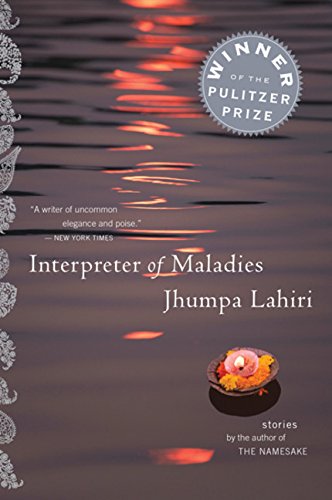
#1 Interpreter of Maladies by Jhumpa Lahiri
 The Interpreter of Maladies is a collection of short stories by multiple award-winning author Jhumpa Lahiri. Each story is incredibly detailed both in setting and character and vary in location and genre. While some are set in the United States, others are based in India and while some are set in times gone by, others are set in more recent times. But what Jhumpa manages to accomplish is to take the reader through the different time-lines of her stories effortlessly. They end, sometimes, rather abruptly but not in a way that would make the reader uncomfortable. The book is named after one of the stories in it about a part-time taxi driver who also works as a translator at a doctor’s clinic. There are stories of love, loss and everything in between with a distinct Bengali touch in at least one character in almost every one of them.
 Raymond Champs is an illustrator of assembly manuals for a home furniture company who is convinced that everybody is sick. Mentally. He believes that everyone around him and the world in general is suffering from clinical depression and they’re either hiding it or not aware of it yet. But to back his theory, he needs proof. Proof that he can then show to the world and hopefully help save the world. He sets out on making a survey to test his theory and distributes it to everyone in his office. The story follows Raymond as he receives responses to his survey from everyone including his boss using whose name he had started this entire experiment in the first place.
 #3 The Dark Horse
 When Mary, the widow of Wade Barsad, confesses to having shot her husband everyone believes her. Wade had set the barn on fire, killing 8 of Mary’s prized horses. Nobody had any doubt that this was a crime of vengeance and Mary was certain to be found guilty of murder. Nobody, except Walt Longmire the sheriff in-charge of the prison where she was being held. When Walt digs deeper into the case, he finds that almost everyone in town had a reason for wanting Wade dead.
 #4 The Trials and Tribulations of Life


#5 Fumbling the Future: How Xerox Invented, Then Ignored, The First Personal Computer
 The story of Steve Jobs and a team of Apple employees going on a tour of Xerox’s Palo Alto Research Center (PARC) is tech folklore now. On seeing Xerox’s Alto computer which had a bitmap display with pictures (“icons”), a pointing device to select them (the mouse) and multiple windows, the Apple co-founder was amazed that Xerox wasn’t selling this marvel already. The Apple team went back and used those elements and more to build their own computer and the rest, as they say, is history. But long before that historic moment, Xerox had already dug themselves into a very deep pit.
 Book: Fumbling the Future: How Xerox Invented, Then Ignored, The First Personal Computer.(William Morrow and Company, 1988)
Genre: Non-fiction.
Author: Douglas K. Smith and Robert C. Alexander
Read Time: 8 days
#6 The First Word: The Search for the Origins of Language.
 The First Word is an intriguing read. It explores the various theories about how humans came to use language. It seeks to present multiple points of view to answer a large set of questions about language that we don’t normally think about too much. Is it language that separates humans from the apes? Why is language unique to humans? Did we develop language thanks to the flipping of “genetic switch” that caused a mutation in one ancient human who then passed it on to following generations or did language, like everything else about humans, evolve from nothing? Is there a basic set of rules that all languages have in common? Is there a gene responsible for language?
Christine Kenneally presents a whole host of varied opinions that demonstrates just how complicated this topic is. From Chomsky’s early theories that formed the basis for early research into the origin of language to other theories, some in support and some contrasting, but equally interesting ones that open your mind to whole new area of study.
A book that makes you question something so fundamental in everyone’s life that we often take it for granted. Great read.
Book: The First Word: The Search for the Origins of Language.(Viking Penguin, 2007)
Genre: Non-fiction.
Author: Christine Kenneally
Read Time: 8 days
#7 Smart Citizens, Smarter State: The Technologies of Expertise and the Future of Governing.
 In order to function efficiently and serve the citizenry well, governments face a critical challenge- they need the right people to provide the right answers at the right time. In the traditional form of governance, the “experts” who advice government may not have right answers and very often may not be available when needed. It is hard to believe that in the age of the internet, finding people is a hurdle. Beth Noveck argues that what is fundamentally wrong with this system begins with the definition of who an “expert” is. University degrees and vague titles like “deputy director” tell you close to nothing about the skills and expertise of a person. The other part of the problem is the lack of public engagement in governance. Noveck provides examples like The GovLab’s Network of Innovators that solves the problems of finding expertise and apps like Pulse Point, that notifies registered members of the public (who are certified to administer CPR) when 911 reports that someone has had a heart attack near them thereby saving thousands of lives. The role of the government, needs to be one that enables this sort of public engagement.
Smart Citizens, Smarter State redefines the role of citizenry in governance and the way that government must approach governance. The marriage of technology and governance is one key part of this new paradigm and leveraging citizen’s expertise is another.
A must read on governance innovation and technology’s role in it.
Book: Smart Citizens, Smarter State: The Technologies of Expertise and the Future of Governing.(Harvard University Press, 2015)
Genre: Non-fiction.
Author: Beth Simone Noveck
Read Time: 8 days
#8 This Unquiet Land.

Barkha Dutt is one of India’s most prominent journalists. While she’s found herself embroiled in controversies ranging from being accused of compromising the position of Indian soldiers during the Kargil war to incurring Narendra Modi’s wrath which continues to the day, she has seen and reported it all. Wars, kidnappings, hostage situations, secret envoy meetings and everything in between. This Unquiet Land is Barkha’s summary of India over the past two decades. While it’s intriguing because of the backroom stories it tells and compelling because of the narrative it so brilliantly describes, the greatest quality of this book is the honesty with which it is written. Barkha does not attempt to hide behind nuances or word play and offers her take on major events in India while exposing the fault lines that run deep through the Indian society at the same time. The book shot to unwelcome glory when it received less-than-flattering reviews online almost as soon as it released because of right-wing internet trolls who aren’t exactly Barkha’s biggest fans.
Amartya Sen wrote a book that aptly described a large number of us as “Argumentative Indians”. It is a title I found fascinating because of the simplicity with which it describes a complex people. “This Unquiet Land” is another one of those thoughtful titles which does a magnificent job of describing our nation.
Book: This Unquiet Land (Aleph Book Company, 2016)
Genre: Non-fiction.
Author: Barkha Dutt
Read Time: 4 days
#9 Good Omens
 When heaven and hell go to war on earth the outcome is obvious- Armageddon. But the only problem is that the antichrist in charge of the event has been misplaced. An angel and, a liberal devil set out to find him before it’s too late. But there are others who must find him too in order to fulfill the ancient prophecies. Good Omens is about the journey of all these characters to the end of the world as we know it. The story is witty and gripping and the last part of the book is an absolute must read for every single person on our disturbed planet. You’ll need to read the book to find out why and it’s no wonder the book has cult following.
#10 A Thousand Splendid Suns
 This book is a heartbreaking story that captures the history of violence and instability in Afghanistan through the eyes of three generations of Afghans. The most incredible part of this book is how well Khaled Hosseini tells the story of the unrest without focusing on the actual conflict but instead focusing on the impact it had on one family. His descriptions are haunting and stay with you well after you’re done reading the book and without a doubt will bring more than a tear to your eyes. With so much war and violence around the world, this book makes you stop and think about the people affected by it less as numbers and figures and more as human beings. Without a doubt, this book is a must read.
 Book: A Thousand Splendid Suns
Genre: Fiction.
Author: Khaled Hosseini
Read Time: 6 days
#11 Railonama

Book: Railonama
Genre: Short Stories
Author: Anupama Sharma
Read Time: 2 days




 Dudurudh
Leave a reply to Tamblyn Cancel reply