One of the candidates in my constituency (and it sounds like this is the case in several constituencies), is a self-declared button pressing machine. He is a product of my generation so I attach no blame to him. Raised in an educational enviornment that rewards rote-learning, this candidate has A LOT memorized. They’re mostly marketing materials from the BJP and of course, he and his colleagues are entitled to reciting those like children do nursery rhymes.
Unfortunately, they have no opinions of their own. The candidate in Bangalore (South) is campaiging from the same script as the one from Kollam and the one from Coimbatore. You can turn on the news and hear the same choir song from them all.
Now, I don’t care much about the BJP’s campaign strategy (and I suspect they care little about my criticism of it). Whether it ends up being electorally successful or not too is besides the point.
My concern is two-fold:
First, is my deeply personal biases: I don’t like either of the Catastrophe Cousins leading that party and this government. I don’t like their policies. I don’t like their arrogance. I don’t like their destruction of institutions. I don’t like their very heavy god-complex, their tendency to spill their personal insecurities into policy decisions and their generally over-paternalistic vibes.
Secondly and more importantly. They are destroying the concept of Parliamentary Democracy. The elections that have commenced today are to elect to legislators to the Lok Sabha. It is not to elect a Prime Minister. The Lok Sabha is a deliberative body – not a post office that stamps and seals diktats from The Supreme Leader. It is socially and historically important for India’s parliament to go back to being a body of deliberation and negotiations on issues of national importance. In the past 10 years, there have been few debates in parliament worth remembering. Important laws of great consequence have been passed by that body with little or no debate. In fact, on many occasions, draft laws have not gone through public consultation or even standing committees.
These might seem procedural but these are the main places where legislators exercise their expertise, rights and raise the voice of their constituents. Disagreement among parliamentarians of the same party is desirable in that environment. Realistically, any law a government with a large majority like this one brings, will easily pass in Parliament. But that makes it even more surprising that they wouldn’t encourage some level of discussion and instead rely on brute force mathematics.
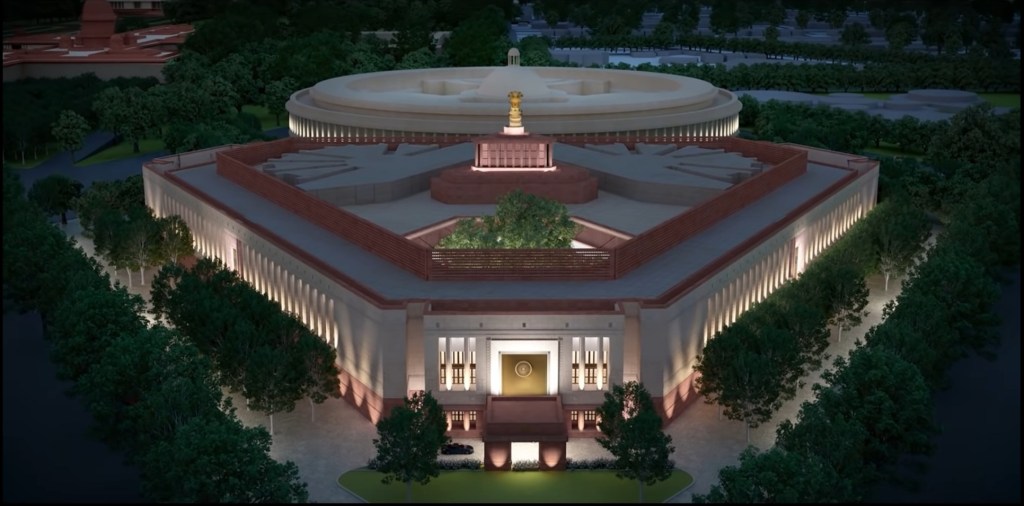
If all these MPs do in that fancy new parliamentary building is to show up thrice a year, clap when The Supreme Leader makes a speech and then press the “Aye” button every time his ministers wave a piece of paper, then why are we paying for these massive elections and sending 543 individuals to Delhi? That set of tasks requires no cognitive ability and any telephone post with an attachable arm can carry those out.
Lok Sabha has a bad reputation of being a chaotic, noisy, argumentative place. But that IS India. We’re a large, noisy, crowded country with all sorts of diverse needs that are often in contradiction with each other. And having conversations in that environment is not easy. Our democracy has always been a work in progress for that reason I am not calling for going back to some golden age of Parliamentary democracy. I am calling for us to move towards it.
Unfortunately, the group of individuals who are now campaigning are attempting to remove any semblance of significance of an institution that protects the interests of a diverse people.
So then the question arises: What if there are no “meritorious” candidates. The reality of Indian politics is that often there are no good candidates. But my approach to this, is simple: If there’s a candidate that does not have the spine to stand up for themselves, they’re incapable of standing up for the interests of the most vulnerable of their constituents. Any candidate who will listen to public discourse or has the freedom to do so, is the better candidate. There was a time when public pressure forced governments to back off from bad decisions and that exertion of public pressure is via our local candidates. If we (and those who are marginalized in our communities) do not have those levers, we no longer live in a representative democracy.
There are few physical symbols of this attempted departure from a representative, parliamentary democracy to an almost monarchical presidential one than the “Sengol” that the BJP installed in the new parliament. Of course ancient Indian heritage must be a protected. But a symbol of an ancient monarchy belongs in a museum with all the glory it deserves – not in a Parliament that is antithesis of everything a monarchy stands for.
When you go out to vote in these elections, study your candidate. Read their statements. Think about what THEY stand for as individuals and what they will contribute by entering the hallowed halls of one the greatest deliberative institutions in the world.

 Dudurudh
Leave a comment